
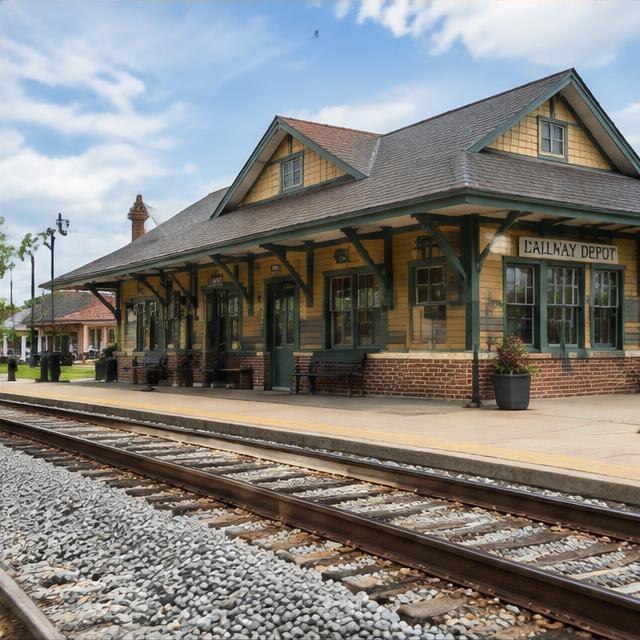
Matthews began as a railroad stop carved out of cleared Piedmont forest, and its historic center still shows it. Understanding how the town grew — from Stumptown to a farming community to a Charlotte-area suburb — explains the mix of older streets and newer neighborhoods that defines it today.
From Stumptown to Matthews
Before it had a formal name, the settlement was known informally as Stumptown — reportedly for the tree stumps left behind as settlers cleared the land for farms. The arrival of the railroad in the 1870s turned the clearing into a town: Matthews was incorporated in 1879 and named for Edward Watson Matthews, a director of the railroad whose line connected local farms to regional markets. The compact commercial blocks near the tracks still mark where that original town took shape.
A railroad and farming town
For most of its first century, Matthews was a small agricultural community. Cotton and other farm goods moved out on the rail line, and the downtown that grew beside the depot served the surrounding farmland with stores, a bank, and services. That era left a legacy that is still visible: a walkable main street scaled to a small town rather than a city, older homes on the streets near the center, and community institutions that have anchored local life for generations.
The suburban transformation
Growth accelerated in the late twentieth century as Charlotte expanded southeast and highway access improved. Farms gave way to subdivisions, shopping corridors and new schools, and Matthews became one of the region's established suburbs. That timing explains the housing landscape today: much of the area's housing dates from the 1970s onward, while the downtown core retains its older, railway-era character.
A downtown that kept its identity
Unlike some suburbs that lost their centers to growth, Matthews kept its historic downtown as a civic heart. Historic buildings, community events and local organizations keep the town's past visible, and the area around the old rail line remains the setting for markets, festivals and everyday gathering. Anyone renovating an older property near downtown should ask the Town about any preservation or design guidelines that may apply before planning exterior changes.
What the history means for residents
The town's layered growth matters practically. Older streets near downtown offer walkability and mature trees; newer neighborhoods offer larger lots and more recent construction. Jurisdiction, schools and services can differ from one street to the next, so the address-check page in this guide explains how to confirm the details for a specific property. For current preservation, planning and town information, consult official Town of Matthews resources rather than relying on any summary, including this one.
This guide is published by Nicholas and Miriam Peters and is not a live information service. Details can change. Confirm schools, jurisdiction, business hours, amenities, and property rules with the relevant official source or organization before making decisions.